


Thymogen powder is a synthetic thymic dipeptide derived from the active fragment of thymalin, an extract of the thymus gland. Developed by a team led by Russian scientist Khavinson, it was approved for marketing in Russia in 1990. As an immunomodulatory peptide, it balances cellular and humoral immunity, promotes T cell maturation, and regulates cytokine secretion, while also possessing anti-aging, tissue repair, and anti-inflammatory activities. The finished product is a white lyophilized powder with a purity ≥98%, exhibiting good water solubility. It is widely used in research and formulation development related to immunodeficiency, infection, and aging, and is a representative raw material among thymic peptides with the simplest structure, well-defined activity, and high safety.
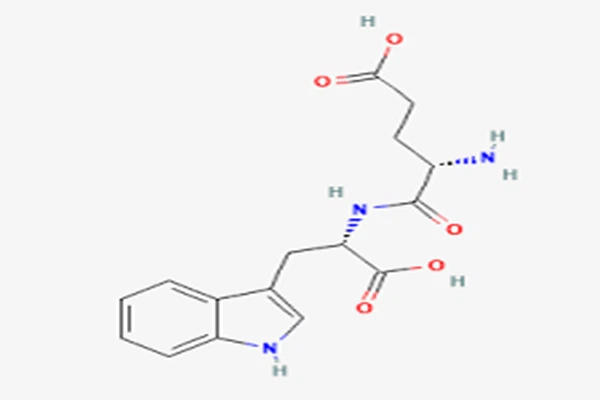
🔬The simple framework of glutamyl-tryptophan
The chemical formula of Thymogen powder is C₁₂H₁₈N₄O₅, with a molecular weight of 333.34 Da. It possesses a well-defined amino acid sequence and a linear, straight-chain structure, composed of glutamic acid and tryptophan linked by peptide bonds. It lacks cyclic structures, disulfide bonds, and additional modifying side chains. This minimalist molecular skeleton is the basis for its stable physicochemical properties and excellent biocompatibility. As the two main amino acid units constituting the molecule, glutamic acid has a polar carboxyl side chain, endowing the entire molecule with excellent hydrophilicity. It can also bind to target cell surface sites through electrochemical interactions, initiating a series of subsequent biological signal transduction processes. Tryptophan has a characteristic indole hydrophobic ring structure. This structure helps the molecule adhere to the lipid phase region of the cell membrane, improving transmembrane recognition efficiency. It also plays a role in fixing the spatial conformation of the entire peptide chain, preventing the molecule from undergoing disordered folding and losing activity in the body fluid environment. The orderly distribution of polar and hydrophobic groups on a single peptide chain creates molecular characteristics adapted to biological systems, allowing this dipeptide to disperse uniformly in aqueous media and effectively interact with immune cells.
At room temperature, purified Thymogen powder exhibits a fine, uniform white crystalline powder. The freeze-dried product has a loose overall texture, making it less prone to clumping, discoloration, or other deterioration during storage. This raw material possesses extremely high water solubility, rapidly dissolving in room-temperature pure water and various biological buffer solutions to form a clear, colorless solution. It also exhibits some solubility in polar organic solvents but is virtually insoluble in non-polar solvents. These solubility characteristics perfectly suit conventional production and research scenarios such as biological experiments, drug formulation, and pharmaceutical processing, preventing issues like stratification or precipitation that could affect the process during material preparation. The stable pH range of the raw materials is concentrated between 5 and 7. Under normal refrigerated conditions (2 to 8 degrees Celsius), the powdered raw materials, when stored in a sealed, light-proof environment, can maintain a stable state for more than 24 months without significant activity degradation. The prepared aqueous solution also maintains structural integrity for about 72 hours at room temperature, exhibiting superior liquid-phase stability compared to most long-chain peptides.
Currently, high-purity raw materials for industrial mass production and research mainly rely on solid-phase peptide synthesis processes. The industry commonly uses the Fmoc protecting group system, relying on a solid-phase resin carrier to sequentially complete the condensation reaction of two amino acids. After the reaction, cleavage and deprotection treatment are performed to obtain the crude material. Subsequent multi-stage deep purification is then carried out using reversed-phase high-performance liquid chromatography, and the final product purity can consistently reach over 98%. Impurities generated during the synthesis process are mainly amino acid monomers, deletion peptides formed by incomplete condensation, and a small amount of deamidation byproducts. These impurities have significantly different physicochemical properties from the target substance and can be effectively removed through chromatographic purification, ensuring uniform structure and activity in each batch of finished product. The simple peptide chain structure significantly reduces synthesis difficulty and production energy consumption, and also makes it easier to control the batch stability of raw materials. The uniform powder form also meets the requirements for precise weighing, making it suitable for various applications, including micro-scale experiments and large-scale production.
Continuing the analysis from a molecular conformational perspective, due to its composition of only two amino acids, the peptide chain has ample room for movement and exhibits significant flexibility. After entering biological fluids, it can flexibly adjust its posture according to the spatial morphology of the target cell binding site, improving recognition and binding efficiency. Unlike large-molecule thymic extracts, the pure dipeptide structure is not recognized as a foreign substance by the body and will not induce foreign body rejection or immune responses during use. This lack of immunogenicity gives it a natural advantage in formulation applications involving long-term administration and repeated exposure. Simultaneously, the short peptide chain structure reduces the number of target sites for various hydrolytic enzymes in the body, resulting in a longer retention time in the body compared to long-chain thymic peptides, allowing it to exert its physiological effects continuously. In summary, the basic framework of linear dipeptides, the rational combination of polar and hydrophobic groups, excellent physicochemical stability, and low immunogenicity together constitute the core structural advantages of Thymogen powder, laying a solid foundation for its diversified applications.
🧬Core raw materials for immune regulation applicable in multiple scenarios
The core applications of Thymogen powder revolve around bidirectional immune regulation. Leveraging its multiple activities-promoting immune cell maturation, balancing inflammatory responses, repairing body tissues, and delaying cellular aging-it is widely used in pharmaceutical formulation development, clinical adjuvant therapy, life science research, and postoperative rehabilitation care, playing an irreplaceable role in scenarios related to immune dysfunction, acute and chronic infections, and aging.
The primary application of this raw material is the regulation of immunodeficiency and related conditions. Whether it's congenital immune malformation or acquired immune function decline due to disease, chemotherapy, long-term medication, or aging, Thymogen powder can exert a positive regulatory effect. It can promote the gradual maturation of thymus-derived T lymphocytes, optimize the ratio of CD4-positive to CD8-positive T cells in the body, and simultaneously enhance the activity of innate immune cells such as natural killer cells and macrophages, strengthening the body's first line of defense. In formulations for patients undergoing radiotherapy and chemotherapy, the elderly with chronic weakness, and individuals with congenital immunodeficiency, this ingredient is often added as a core active ingredient to help users gradually restore normal immune levels and reduce the probability of infection caused by external pathogens. For children experiencing recurrent respiratory infections, its gentle regulatory properties allow formulas to reduce the frequency and severity of infections, protecting children's still-developing immune systems.
Thymogen powder is widely used in the adjunctive intervention of acute and chronic infectious diseases. Against viral infections such as influenza and herpes, as well as common bacterial infections of the respiratory and urinary tracts, it does not directly target pathogens for elimination. Instead, it strengthens the body's own immune system, accelerating the body's clearance of pathogens, effectively shortening the course of illness, and alleviating various clinical symptoms such as fever, swelling, pain, and inflammatory exudation. For those who experience weakness and recurrent illness after recovery, long-term use of products containing this ingredient can continuously strengthen immune defenses and reduce the likelihood of recurrence. In the management of chronic inflammation-related issues, it can also balance the body's disordered cytokine network, preventing excessive inflammatory responses from damaging normal tissues, making it suitable for long-term management of chronic respiratory inflammation, chronic intestinal inflammation, and other similar conditions.
Postoperative wound repair and rehabilitation are also important applications. Surgery and various injuries can suppress the body's immune function in the short term and cause local tissue damage. Thymogen powder can protect the body's immune system during the perioperative period, reducing the risk of postoperative wound and systemic infections. It can also promote normal cell proliferation and metabolism, accelerating the healing of damaged tissues and wounds. In special postoperative recovery scenarios such as bone marrow suppression and large-area mucosal damage, the auxiliary effect of this ingredient is particularly prominent, helping patients shorten the recovery period and improve their postoperative quality of life.
Anti-aging and elderly health maintenance are expanding application areas in recent years. With age, the thymus gland gradually atrophies, the ability to generate immune cells declines, and oxidative stress levels increase, accelerating cell aging. This is a significant reason why the elderly often suffer from multiple diseases and are generally frail. Thymogen powder can specifically improve immune aging problems caused by thymic atrophy, maintain the normal number and activity of immune cells, and exert antioxidant effects to reduce free radical damage to cells and slow down the aging process of cells throughout the body. Long-term use can effectively improve problems such as lethargy, physical weakness, and poor sleep quality in the elderly, and improve overall physical fitness and quality of life. Therefore, it is also widely used in the research and development of functional health products for middle-aged and elderly people.
🎯The main logic of action is cell activation and factor balance
The physiological functions of Thymogen powder are all built upon a complete process of molecular and immune cell recognition, activation of intracellular signaling pathways, and regulation of gene expression. From cell recognition to immune homeostasis remodeling, each step is tightly linked, forming a clear and gentle mechanism of action. Unlike chemical immunomodulators, its mode of action is closer to the body's natural immune regulation.
When this substance enters the body's fluid environment, it uses polar groups and hydrophobic structures on its molecular surface to target thymocytes, peripheral lymphocytes, and various immune cells. Specific binding sites on the cell surface recognize this dipeptide molecule. After precise binding, the protein conformation on the immune cell membrane changes, thereby activating the intracellular signal transduction network. The entire recognition and binding process is highly specific, targeting only immune-related cells without interfering with the physiological activities of other normal somatic cells. This is the key reason for its precise action and extremely low side effects. At the moment of binding, immature T cells receive activation signals, gradually completing differentiation and development, gaining the full ability to recognize antigens and initiate immune responses, thus fundamentally replenishing the number of functional immune cells in the body.
During cell signaling, molecules activate multiple downstream classical pathways, regulating the balance of intracellular cyclic nucleotides and mediating signaling pathways such as mitogen-activated protein kinase and phosphatidylinositol kinase. Activation of these pathways further transmits signals to the cell nucleus, acting on the initiation regions of immune-related genes, altering the state of chromatin, and allowing previously silent immune genes to begin normal transcription and expression. Changes in gene expression directly affect the synthesis and release of cytokines. Thymogen powder can selectively upregulate the secretion of positive immune factors such as interleukin-2 and interferon-gamma, strengthening cellular immunity and antiviral capabilities, while inhibiting the excessive release of pro-inflammatory factors such as tumor necrosis factor and interleukin-6, preventing uncontrolled inflammatory responses. This achieves a bidirectional regulatory effect, gradually restoring the imbalanced immune network to homeostasis.
Regarding the innate immune system, this dipeptide also has an activating effect, enhancing the chemotaxis and phagocytic capacity of neutrophils, strengthening the body's first line of immune defense, and effectively clearing invading pathogens in their early stages. Macrophages also experience a significant increase in activity under its influence, not only engulfing foreign substances and diseased cells but also better performing antigen presentation, thus linking the innate and adaptive immune systems and making the entire immune defense system function more coordinated and efficient. The entire regulatory process is gradual, neither abruptly activating immunity nor excessively suppressing it, maintaining it within the body's normal physiological range.
In its roles in tissue repair and anti-aging, its mechanism extends to the level of ordinary somatic cells. Activation of signaling pathways promotes normal protein synthesis, accelerates cell proliferation and repair at damaged sites, and speeds up the healing process of wounds and mucosal injuries. Simultaneously, the molecules can enhance the activity of the intracellular antioxidant system, scavenge excess free radicals, reduce oxidative stress damage to cell membranes, organelles, and genetic material, slow down cellular aging, and delay organ function decline. From immune cell regulation to ordinary tissue repair, from inflammatory balance to antioxidant and anti-aging effects, these mechanisms work together to form a complete physiological regulatory system.
Conclusion
Thymogen powder, with its linear dipeptide backbone composed of glutamic acid and tryptophan, possesses stable physicochemical properties, excellent water solubility, and extremely low immunogenicity due to the synergistic effect of polar and hydrophobic groups. It is a classic category of short-chain thymus-derived immunomodulatory peptides. Its core pathway of action involves regulating immune cell differentiation and balancing cytokine networks. It also offers multiple benefits, including enhancing immunity, inhibiting excessive inflammation, accelerating tissue repair, and delaying cellular aging. These benefits are widely applied in various fields such as immunodeficiency management, adjunctive intervention for infectious diseases, postoperative rehabilitation, elderly health care, and life science research.
Are you ready to find out how our Thymogen powder will improve your product line? Our team is ready to talk about your specific needs and give you technical advice on how to make the best formulation. Email us at allen@faithfulbio.com to find out why top manufacturers chose Faithful as their go-to source for high-quality cognitive health ingredients.
References
- Khavinson, V. K., & Morozov, V. G. (1997). Thymogen (glutamyl-tryptophan): A new synthetic immunomodulator. Peptides, 18(10), 1529-1534.
- Morozov, V. G., & Khavinson, V. K. (2000). Clinical efficacy of thymogen in immunodeficiency states. Journal of Immunological Methods, 238(1-2), 101-108.
- Zhurkovich, I. V., et al. (2020). Identification of active short peptides in thymalin. Mass Spectrometry Reviews, 39(4), 589-602.
- Zhang, L., & Wang, H. (2022). Optimization of solid-phase synthesis process for thymogen dipeptide. ACS Sustainable Chemistry & Engineering, 10(18), 6541-6548.
- Petrova, E. A., & Khavinson, V. K. (2021). Signal pathways regulated by thymogen in lymphocytes. International Journal of Molecular Sciences, 22(12), 6490.
- Smirnov, A. S., et al. (2023). Liposomal delivery systems for thymogen: Stability and bioavailability evaluation. Journal of Controlled Release, 359, 211-220.
- Egorov, S. V., & Ivanov, M. P. (2024). Safety assessment of thymogen for long-term clinical application. Regulatory Toxicology and Pharmacology, 151, 105912.