


The key properties of Methylene Blue Powder to consider in custom raw material blends include chemical identity, assay level, moisture content, particle size, solubility, and impurity profile. These characteristics help determine the material's composition, physical behavior, and suitability for further processing. Evaluating them together provides a clearer understanding of whether a particular product meets the requirements of a custom formulation.For chemical raw material applications, each property should be considered in relation to the intended blending process and the specifications of the final product. Assay and impurity levels provide information about material composition, while moisture content and particle size can influence powder handling and mixing conditions. Solubility is also relevant when the material needs to be incorporated into a liquid preparation or another compatible system.
Rather than relying on a single specification, evaluating the overall quality profile of Methylene Blue Powder helps formulation teams make more informed material selections.Faithful Chemical, a raw material powder supplier serving B2B research clients, can provide you with comprehensive testing certificates containing the relevant characteristics you need to know.
Key Properties
Understanding the basic properties of Methylene Blue Powder is the first step in evaluating its suitability for a particular formulation. Each specification describes a different aspect of the material, and the relevant parameters should be reviewed according to the intended application.
Chemical Identity
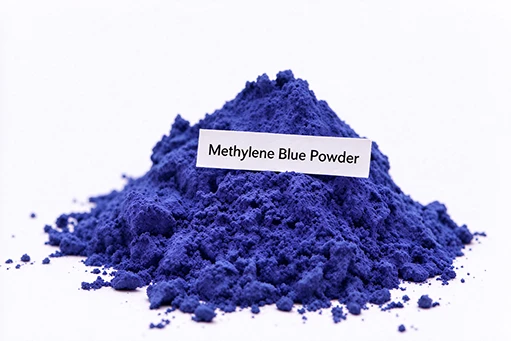
Methylene Blue (CAS 61-73-4) is a cationic thiazine dye. Its anhydrous chloride form has the molecular formula C₁₆H₁₈ClN₃S and a molecular weight of 319.85 g/mol, while the trihydrate form has a molecular weight of approximately 373.90 g/mol. Confirming the hydration state is important because it affects the actual compound content by weight.
Assay Level
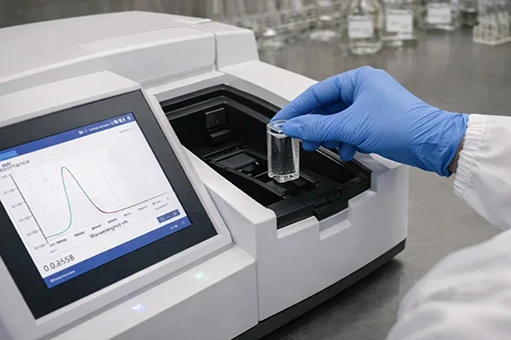
Assay indicates the content of the specified methylene blue compound. Results reported on an as-is basis may differ from those calculated on a dried basis, so the reporting basis must be clear when calculating raw material proportions. The actual assay range for the supplied grade should be confirmed from its product specification or COA.

Moisture Content
Moisture content can affect powder handling and formulation calculations. For hydrated methylene blue, water of crystallization should be distinguished from additional moisture. Loss on drying (LOD) may reflect both, depending on the test conditions, and should not automatically be interpreted as free moisture alone.

Particle Size
Fine particles may form agglomerates or adhere to equipment, while coarse particles may require more mixing to achieve uniform distribution. Particle size distribution, including D10, D50, and D90, provides a more complete description than average particle size alone. The actual particle size range of the supplied grade should be checked before setting blending parameters.

Solubility
Methylene Blue Powder is soluble in water, but its dissolution behavior in ethanol-containing or mixed-solvent systems should be evaluated separately. A preliminary comparison can use a 1 g/L solution in purified water at 20–25°C, stirred for 10 minutes under consistent conditions. These are suggested screening conditions, not an official test standard or a guaranteed production condition.

Impurity Profile
The impurity profile may include heavy metals, arsenic, sulfate, and water-insoluble matter, depending on the product grade and its intended requirements. Buyers should review the actual test items, analytical methods, and acceptance limits in the product specification rather than relying on a general purity claim.
If you are looking for Methylene Blue Powder for your raw material formulations, Faithful Chemical can provide product information and supporting documentation to help you evaluate its suitability. Contact our team to discuss your specifications, packaging requirements, and sourcing needs.
Blending Requirements
Methylene Blue Powder is used in different raw material formulations, and its suitability depends on more than its stated purity. Chemical form, assay, moisture content, particle size, and compatibility with other ingredients can all affect blending performance and final product consistency.
Particle Size Matching
Particle size differences between Methylene Blue Powder and other ingredients can lead to segregation during blending, transportation, or discharge. For dry powder formulations, comparing the D10, D50, and D90 values of each ingredient can help identify significant differences. Where necessary, particle size adjustment or pre-blending may improve distribution.
01
Mixing Sequence and Uniformity
For formulations containing a small proportion of Methylene Blue Powder, adding the full quantity directly into a large batch may make uniform distribution more difficult. A practical approach is to first mix the methylene blue with a small portion of a compatible carrier, then gradually incorporate this premix into the remaining ingredients. Mixing time, equipment type, and batch size should be established through trials rather than using one fixed setting for every formulation.
02
Solvent Compatibility
For liquid blends, water is a suitable starting solvent because Methylene Blue is water-soluble. However, ethanol, salts, surfactants, and other formulation ingredients may change dissolution behavior or cause precipitation. Test the dye in the complete solvent system, not only in pure water. Record the solvent composition, ingredient concentration, temperature, and mixing time so that the results can be reproduced.
03
Moisture and Storage Conditions
In dry blends, moisture can contribute to caking and affect powder flow, particularly when ingredients have different moisture characteristics. Keep materials in sealed packaging and minimize exposure to humid air during weighing and blending. The acceptable moisture level and storage conditions should be determined according to the specifications of the complete formulation.
04
Faithful Chemical supplies Methylene Blue Powder for various raw material sourcing requirements. Contact our team for product details, available specifications, and packaging information.
Quality Control
Quality control helps verify whether each batch of Methylene Blue Powder meets the requirements of a specific formulation. In addition to checking the reported assay, buyers should review the test methods, acceptance limits, and batch records to assess material quality and consistency.

COA and Specification Review
Review the Certificate of Analysis (COA) for each batch and compare the results with the product specification. Key items include assay, moisture or loss on drying, identification, and any specified impurity limits. Check whether assay is reported on an as-is or dried basis before using the value in formulation calculations.

Identity and Assay Testing
Chemical identity and assay should be verified using methods appropriate to the product grade. UV-Vis spectroscopy can help assess the characteristic absorption of methylene blue, while a validated quantitative method is needed to determine assay accurately. The test method and acceptance criteria should be consistent across batches.

Moisture and Particle Size Testing
Moisture testing should distinguish the effects of hydration from additional water where relevant. Loss on drying and Karl Fischer titration measure different aspects of moisture and should not be treated as interchangeable. For particle size, laser diffraction or sieve analysis can be selected according to the powder's size range and the specification being checked.

Batch-to-Batch Consistency
Compare COAs from multiple production batches rather than relying on a single test report. Pay particular attention to changes in assay, moisture, particle size distribution, and impurity results, as these differences may affect weighing, blending, and dissolution. Actual batch records and test results are needed to establish the supplier's consistency.
Faithful Chemical can help clarify the quality documentation available for Methylene Blue Powder, including batch-specific test results and applicable analytical methods. Contact our team to obtain the relevant quality information for your sourcing evaluation.
Formulation Considerations
The formulation process depends on whether Methylene Blue Powder is used in a dry blend, an aqueous solution, or a mixed-solvent system. Each type presents different compatibility and processing requirements, so testing should reflect the actual ingredients and intended production conditions.
Dry Powder Formulations
For dry blends, consider the particle size and bulk density of Methylene Blue Powder relative to the other ingredients. Large differences can increase the risk of segregation during mixing and handling. A small-scale trial can help determine whether pre-blending with a compatible carrier is needed before adding the material to the main batch.


Water-Based Formulations
Methylene Blue dissolves in water, making purified water a practical starting point for aqueous formulations. For initial compatibility screening, prepare a 1 g/L solution at 20–25°C and stir for 10 minutes. These are suggested screening conditions, not a standardized test or a guaranteed production setting. Check the resulting solution for undissolved particles, precipitation, and color uniformity.
Mixed-Solvent Formulations
Do not assume that solubility in water guarantees compatibility with ethanol-containing or other mixed-solvent systems. Solvent ratios can change the dye's dissolution behavior, while salts and other additives may affect solution stability. Test the complete formulation at its intended ingredient concentrations and record the solvent ratio, temperature, and mixing time.

pH and Ingredient Compatibility
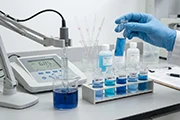
The pH and ionic composition of a formulation may affect methylene blue's behavior, particularly when combined with salts, surfactants, or other functional ingredients. Check for precipitation, color changes, and changes in solution clarity after mixing. The acceptable pH range and ingredient concentrations should be established through compatibility testing rather than assumed from the properties of methylene blue alone.
Faithful Chemical supports raw material sourcing for formulation projects involving Methylene Blue Powder. Contact our team to discuss your intended application and sourcing requirements, and obtain product information for your evaluation.
Supplier Advantages
Why Choose Us
Selecting a supplier for Methylene Blue Powder involves more than comparing price and assay. Quality documentation, testing support, customization options, and supply arrangements also matter when sourcing raw materials for custom blends. Faithful provides several services and resources that can support these procurement requirements.
Quality Control and Testing Support
Faithful maintains an independent laboratory and a quality control system covering different stages of production. Its listed testing capabilities include heavy metals, solvent residues, pesticide residues, microbiological parameters, and physical properties. For Methylene Blue Powder, buyers should confirm which tests are applicable to the specific grade and available for each batch.
Technical Documents
Faithful lists several documents for customers, including Certificates of Analysis (COA), Technical Data Sheets (TDS), Safety Data Sheets (MSDS), and Methods of Analysis. These documents help buyers review product specifications, handling requirements, and test results before incorporating the material into a formulation.
Customization and Packaging
Faithful offers OEM services, customized raw material solutions, and different packaging options. For custom blends involving Methylene Blue Powder, buyers can discuss required assay levels, particle size, packaging formats, and other specifications. The feasibility of each requirement should be confirmed before placing an order.
Supply and International Logistics
Faithful serves customers in international markets and lists multiple shipping options, including DHL, FedEx, UPS, and other transportation services. The company also reports warehouse services in Germany and California. Buyers should confirm current stock, minimum order quantities, delivery schedules, and the availability of these logistics arrangements for Methylene Blue Powder.
FAQ
Conclusion and Reference
Conclusion
Selecting Methylene Blue Powder for custom raw material blends requires evaluating its chemical form, assay basis, moisture content, particle size, and compatibility with other ingredients. These properties influence material calculations, blending uniformity, and dissolution performance. Before placing an order, review the product specification and batch COA, and confirm any formulation-specific requirements with the supplier. Where compatibility or processing conditions are uncertain, conduct a small-scale trial using the actual formulation.
Faithful Chemical provides Methylene Blue Powder for raw material sourcing, with product details and documentation available to support your evaluation. Contact our team to discuss your purchasing requirements and obtain a quotation.
If you require Methylene Blue Powder research or production
Please contact Faithful Chemical Click
Email: allen@faithfulbio.com
WhatsApp: +86 13137770562.
Reference
1. National Center for Biotechnology Information (NCBI). PubChem Compound Summary: Methylene Blue.
2. European Chemicals Agency (ECHA). Information on Chemicals.
3. World Health Organization (WHO). The International Pharmacopoeia.
4. International Organization for Standardization (ISO). ISO 13320:2020 - Particle Size Analysis - Laser Diffraction Methods.
5. United States Pharmacopeia (USP). General Chapter - Water Determination.
6. International Council for Harmonisation (ICH). Q2(R2) - Validation of Analytical Procedures.
7. International Council for Harmonisation (ICH). Q6A - Specifications: Test Procedures and Acceptance Criteria for New Drug Substances and New Drug Products: Chemical Substances.