


Trimethoprim powder, also known as trimethoprim powder, is an artificially synthesized antibacterial raw material powder. Its appearance is mostly white crystalline fine powder, and its antibacterial ability is limited when used alone. Its most prominent feature is that it can be combined with many sulfonamide raw materials to enhance the overall antibacterial effect. Therefore, Trimethoprim powder is often referred to as an antibacterial enhancer in the industry. Trimethoprim powder is only used as a raw material and belongs to scientific research raw materials. It cannot be directly used for oral or external administration in humans or animals. Direct contact with it may pose various unknown risks and cannot be equated with finished drugs.
Molecular Structure Characteristics of Trimethoprim Powder
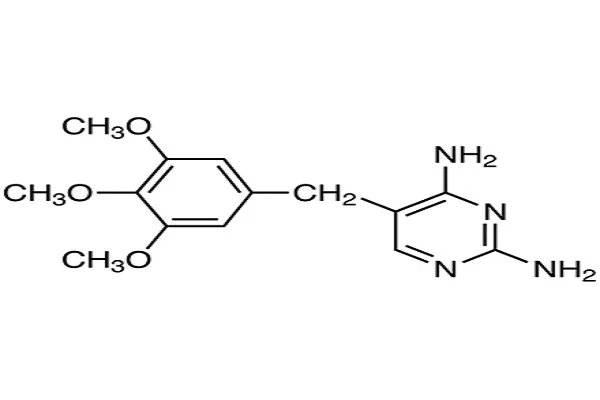
Trimethoprim powder has a simple and stable organic molecular skeleton, with a pyrimidine ring as the core structure and methoxy groups on the side chains. This type of structure determines that Trimethoprim powder can accurately target specific metabolic proteins inside bacteria and will not easily bind to similar proteins in human cells. This is also the basis for its ability to selectively inhibit bacteria. Trimoproxim powder has a relatively small molecular volume and can achieve good dissolution in a suitable solvent environment. Its chemical properties are relatively stable in powder form, and it can maintain its activity for a long time when stored in a dry and dark place, making it less likely to quickly decompose and fail.
The pyrimidine group on the Trimethoprim powder molecule is the most critical component for achieving antibacterial activity. Bacteria need to rely on pyrimidine related substances to synthesize nucleic acids in order to complete their own growth and reproduction, and the molecule of Trimethoprim Powder can precisely embed into the corresponding enzyme protein site, occupying the binding site originally belonging to the substrate and blocking the bacterial metabolic chain. Compared to many quinolone antibacterial materials, Trimethorim has a single target of action. It does not directly damage the gene chain of bacteria, but starts from the nutritional metabolism link, causing bacteria to lack the necessary substances for proliferation and gradually stop dividing.
Trimoproxim powder finished products have undergone purification treatment, with impurity content controlled at a low level, uniform powder particles, and minimal fluctuations in physical and chemical properties between batches. The raw material production process will go through multiple purification, filtration, and drying steps to finally obtain crystalline powder. Trimethoprim powder has a relatively weak solubility in water, and its solubility is significantly increased in some organic solvents. This physicochemical property directly affects its subsequent combination and use. When formulating, it is necessary to consider the solvent system in advance to ensure that Trimethoprim powder can be uniformly dispersed and play its corresponding role.
Trimethoprim powder molecules do not easily disrupt normal mammalian cell metabolic pathways. The way in which human and animal cells synthesize folate differs significantly from the way in which bacteria synthesize folate. Trimethoprim powder is difficult to affect the folate conversion process in host cells, which is also the core reason for its selective action on bacteria. However, long-term or high concentration exposure to Trimethoprim Powder can still bring negative effects at the cellular level, so Trimethoprim Powder is only limited to research at the raw material level and cannot be directly used for individual treatment.
The molecular stability of Trimethoprim powder also has boundaries. When left in a strongly acidic or alkaline environment for a long time, the molecular structure will gradually be destroyed, losing its ability to bind to the target protein. High temperature environments can also accelerate the degradation of Trimethoprim Powder, so storing Trimethoprim Powder requires keeping it cool and dry, isolating it from strong light exposure, and reducing activity degradation caused by environmental factors.
Principle of Antimicrobial Action of Trimethoprim Powder
Bacteria continue to grow and divide without the folate metabolic cycle. Bacteria cannot directly absorb readily available folate from the outside world and must rely on their own enzyme system to synthesize folate step by step. Folic acid is further converted to synthesize DNA, supporting bacterial replication. Trimethoprim powder will specifically inhibit dihydrofolate reductase, directly blocking the key step of folate conversion, preventing bacteria from smoothly converting dihydrofolate into tetrahydrofolate. Without tetrahydrofolate, bacteria cannot complete nucleic acid synthesis and cannot continue to divide and proliferate.
When using Trimethoprim Powder alone, there are limitations to its antibacterial effect. Prolonged use alone can lead to adaptive changes in bacteria, reducing the binding capacity of Trimethoprim Powder and causing tolerance. When Trimethoprim powder and sulfonamide raw materials are used together, the two substances will simultaneously act at two different nodes in the folate metabolism chain, forming a dual blockade, greatly reducing the possibility of bacteria completing folate synthesis smoothly, and the antibacterial effect is doubled. This is also the fundamental reason why Trimethoprim powder is called an antibacterial enhancer.
Trimethoprim powder only has the effect of inhibiting bacterial reproduction, rather than directly and rapidly killing bacteria. After the action of Trimethoprim Powder, bacteria lose their ability to divide and no longer produce new offspring bacteria. The body's own immune cells can gradually eliminate dormant bacteria. For bacteria that are in a dormant state and no longer dividing, Trimethoprim powder is difficult to produce effects. Trimethoprim powder mainly targets bacteria in the rapid proliferation stage.

Different types of bacteria have varying degrees of sensitivity to Trimethoprim Powder. Most Gram negative bacteria and some Gram positive bacteria are inhibited by Trimethoprim Powder, while a few strains have a unique structure of dihydrofolate reductase, making it difficult for Trimethoprim Powder to bind. These strains are naturally insensitive to Trimethoprim Powder. The acidity and alkalinity of the environment can also affect the effectiveness of Trimethoprim Powder. A suitable pH environment can enhance the binding efficiency between Trimethoprim Powder and target enzymes. Deviation from the appropriate range can lead to a significant decline in antibacterial effect.
Continuous exposure to Trimethoprim powder can reduce the effectiveness of the raw material by altering enzyme structure and increasing enzyme expression levels, leading to the development of antibiotic resistance. If Trimethoprim powder is continuously used at high doses, it will accelerate the emergence of bacterial resistance characteristics. Therefore, in raw material related tests, strain tolerance changes will be monitored to evaluate the value of the combination formula in delaying the development of resistance.
The main use of Trimethoprim Powder
Trimoproxim powder, as an active pharmaceutical ingredient, is commonly used for formula combination validation. The most common method is to combine it with sulfonamide raw materials to verify the synergistic antibacterial effect of the complex system, and observe the changes in the inhibitory ability of the two raw materials on various bacterial strains after combined use. In the development process of many complex antibacterial systems, Trimoproxim powder is used as a synergistic component to evaluate the differences in antibacterial ability under different ratios and screen for suitable combination ratios.
Trimethoprim powder can be used to build a bacterial metabolism related testing system, observing a series of changes in bacterial morphology and growth status after the folate metabolism pathway is blocked, and understanding the role of folate metabolism in bacterial proliferation. By relying on Trimethorim, a series of physiological changes can be observed after bacterial metabolism is inhibited, providing a reference for understanding the laws of action of antibacterial substances.
Trimethoprim powder is also used for screening antibacterial formulas. In addition to sulfonamides, it will also be tried to be combined with other types of antibacterial materials to observe whether synergistic effects are produced and explore new compound combinations. In the process of raw material screening, Trimethoprim powder is often used as a reference control material to compare the strength of other new antibacterial substances and facilitate the evaluation of the activity level of new raw materials.

Trimethoprim powder is also used for strain sensitivity testing, to determine the sensitivity of different strains to Trimethoprim powder, record the differences in response of different strains to Trimethoprim powder, and organize strain sensitivity data. At the same time, it will also be used to observe how the strain gradually forms resistance characteristics after continuous exposure to Trimethoprim powder, and record changes in strain characteristics.
Trimethoprim powder is only suitable for use at the raw material level. Trimethoprim powder cannot be directly made into drugs for human or animal use. Finished drugs need to undergo complete formulation development and safety evaluation. Raw material powder is not equivalent to finished formulations. Direct use of Trimethoprim powder at will may pose various risks such as hematopoietic function effects and allergic reactions, requiring strict differentiation between raw materials and medicinal preparations.
The cutting-edge development direction of Trimethoprim
More complex combinations are being continuously explored around Trimethoprim Powder. In addition to traditional sulfonamide combinations, attempts are being made to combine Trimethoprim Powder with other different target antibacterial materials to find synergistic enhancement schemes and reduce the resistance pressure caused by the use of a single material. Different proportioning schemes are continuously tested to find formula ratios that can maximize antibacterial ability while delaying bacterial tolerance.
The direction of dosage form improvement for Trimethoprim Powder is also continuously advancing, improving its water solubility shortcomings and enhancing its dispersibility through carrier wrapping and other methods, allowing Trimethoprim Powder to be uniformly dispersed in more systems and expanding its applicability in various testing systems. Traditional Trimethoprim powder has poor water solubility, which limits the use of certain systems. Carrier modification can improve this shortcoming.
For the response to bacterial resistance, a model based on Trimethorim was established to evaluate various substances that can reverse resistance and search for components that can restore bacterial sensitivity to Trimethoprim Powder, providing new ideas for addressing bacterial resistance. Under long-term selection pressure, a large number of bacterial strains have shown a continuous decrease in sensitivity to Trimethoprim Powder. Relevant directions focus on finding ways to inhibit drug resistance mechanisms and restore the antibacterial activity of raw materials.
The development of derivatives of Trimethoprim Powder is also advancing, with group modifications based on the original molecular skeleton to retain the ability to target dihydrofolate reductase, while enhancing the molecule's binding ability to drug-resistant strains, overcoming the problem of insufficient activity of Trimethoprim Powder in the face of drug-resistant bacteria. The modified derivatives retain the characteristics of the parent nucleus, optimize the binding ability between molecules and target enzymes, and exert effects on strains that have already developed tolerance.
At the same time, Trimethoprim powder is also used as a standard reference material for various antibacterial activity tests, establishing a unified activity evaluation benchmark to facilitate horizontal comparison of the strength of different new active substances. Standardized Trimethoprim Powder batches can ensure comparability of test results across different batches and time periods, reducing data fluctuations caused by differences in raw material batches.
Conclusion
Trimoproxim powder is a classic folic acid metabolism inhibiting antibacterial and synergistic raw material powder. It relies on blocking the bacterial dihydrofolate reduction process to inhibit bacterial division and proliferation. When combined with sulfonamide raw materials, it produces significant synergistic antibacterial effects. Trimoproxim powder is only used as an active pharmaceutical ingredient for formulation and strain related raw material work, and cannot be directly used as a drug. Trimethoprim powder has limited water solubility and long-term use can easily induce bacterial resistance. Currently, the formulation optimization, molecular modification, and formulation optimization of Trimethoprim powder are still being continuously promoted.
Xi'an Faithful BioTech Co., Ltd. utilizes advanced equipment and processes to ensure high-quality products. Our Trimethoprim powder meets international pharmaceutical standards. Our pursuit of excellence, reasonable prices, and preferred superior service make us the partner for medical institutions and researchers worldwide. If you require Trimethorim research or production,Please contact us Click email: allen@faithfulbio.com Or WhatsApp: +86 13137770562.
FAQ
Q1: Is Trimethoprim powder effective when used alone?
A: Its bacteriostatic effect is limited when used alone, and it easily induces bacterial resistance. It is generally better suited for use in combination with sulfonamides; this approach relies on the dual blockade of metabolic pathways to amplify the bacteriostatic effect.
Q2: What category of active ingredient does Trimethoprim powder fall under?
A: Trimethoprim powder is a synthetic antibacterial synergist. It targets bacterial dihydrofolate reductase and does not belong to the quinolone or beta-lactam classes of antibacterial agents.
Q3: Can Trimethoprim powder be used directly to treat diseases?
A: No. Trimethoprim powder is merely a raw pharmaceutical ingredient; it has not undergone formulation processing or comprehensive safety assessment. Direct use poses safety risks, and it cannot be used directly as a finished medication.
References
- Brogden, R. N., & Carmine, A. A. (1982). Trimethoprim: A review of its antibacterial activity, pharmacokinetics and therapeutic use. Drugs, 23(1), 1–24.
- Hitchings, G. H. (1973). Mechanism of action of trimethoprim-sulfamethoxazole. Journal of Infectious Diseases, 128(Suppl), S433–S436.
- Huovinen, P. (2001). Resistance to trimethoprim and sulfonamides. Clinical Infectious Diseases, 32(11), 1608–1614.
- Zinner, S. H. (1989). Trimethoprim: An overview of its mechanism of action, spectrum of activity, and resistance. European Journal of Clinical Microbiology & Infectious Diseases, 8(1), 1–8.
- Wise, R. (1984). Pharmacokinetics of trimethoprim. Journal of Antimicrobial Chemotherapy, 14(Suppl B), 25–33.
- Maskell, J. P., & Sefton, A. M. (2007). Trimethoprim resistance in Escherichia coli. Journal of Medical Microbiology, 56(10), 1301–1307.
- Then, R. L., & Angehrn, P. (1973). The mode of action of trimethoprim. Chemotherapy, 18(4), 209–218.