


Resveratrol Powder is a natural stilbene polyphenol active powder raw material, mostly obtained through plant extraction or chemical synthesis. The proportion of the trans configuration directly determines the actual activity of the resveratrol powder. Resveratrol powder molecules carry multiple phenolic hydroxyl groups, possessing the inherent ability to directly neutralize free radicals. Unlike ordinary antioxidants, resveratrol powder not only simply neutralizes harmful substances but also mobilizes the cell's own defense system to work together. Resveratrol powder has weak water solubility but is more easily soluble in alcohol solvents. Under different concentration conditions, it can exhibit differentiated regulatory effects on various cell types, making it suitable for development and use in multiple downstream applications. It has a high profile in the fields of cell physiological regulation and formulation raw materials.
🧩Structural arrangement characteristics at the molecular level
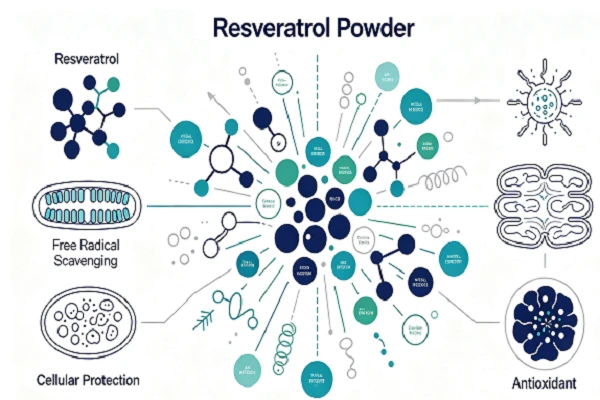
The entire biological performance of Resveratrol Powder originates from its unique molecular framework. The molecule consists of two benzene rings linked by ethylene double bonds, forming a complete stilbene framework. Three phenolic hydroxyl groups are distributed at different sites on the benzene rings; these hydroxyl groups are the core sites where Resveratrol Powder can participate in oxidation reactions. The double bond structure also leads to configurational differentiation, with cis and trans configurations. The trans configuration has a more spacious spatial arrangement, stronger molecular stability, and more prominent physiological activity. The cis configuration is more susceptible to changes caused by external environmental interference, resulting in a significant decrease in its actual efficacy. Routine industrial production of Resveratrol Powder prioritizes controlling the proportion of the trans configuration to ensure a consistent output of its corresponding physiological value in each batch. Many similar polyphenol raw materials do not possess the configurational differences resulting from these double bonds. Therefore, the configurational proportion becomes a crucial aspect of quality control for Resveratrol Powder. Improper storage can cause a significant conversion of the trans component to the cis configuration. Even without a visible change in appearance, the overall effectiveness will drastically decline, making it difficult to achieve the desired results in downstream applications. This is a key point that many users easily overlook when using Resveratrol Powder.
External environmental factors such as light and temperature can interfere with the molecular state of Resveratrol Powder. Prolonged exposure to strong light can alter the position of the double bonds, causing the trans to cis configuration to convert. Sustained exposure to high temperatures can accelerate the breaking of internal chemical bonds, leading to the loss of effective components. Therefore, the storage of Resveratrol Powder must avoid strong light and high temperatures to minimize changes in molecular structure. As a weakly polar substance, the overall molecular structure of Resveratrol Powder directly affects its solubility. It exhibits limited dispersion in aqueous systems but dissolves well in organic solvents like ethanol and propylene glycol. When using Resveratrol Powder in aqueous systems, solubilizing agents are needed to aid dispersion, allowing more Resveratrol Powder molecules to reach the target site. If Resveratrol Powder is directly added to a pure water system, the vast majority of molecules will remain precipitated and suspended in the liquid. The number of effectively dissolved molecules that can reach the cells is very limited, making it difficult to achieve the expected physiological benefits even with large dosages. Many downstream formulations fail to meet expectations not because the Resveratrol Powder itself lacks activity, but because the practical challenges of dissolution and dispersion have not been properly addressed. A large number of active molecules fail to dissolve within the system and cannot reach the target site.

The phenolic hydroxyl group has the ability to donate hydrogen atoms. When encountering reactive free radicals, Resveratrol Powder can release hydrogen atoms, transforming the reactive free radical into a stable substance and terminating the chain reaction of free radical damage. After donating hydrogen atoms, Resveratrol Powder itself transforms into a phenolic free radical intermediate. Thanks to the conjugated system formed by the two benzene rings, this intermediate can achieve its own stability through electron rearrangement, preventing it from becoming a new destructive factor that continues to damage cellular components. Many common antioxidants generate secondary harmful substances after being consumed. Resveratrol Powder, through this conjugated protective system, reduces the probability of secondary damage, which is the most crucial difference between it and many common antioxidant ingredients. Many antioxidant molecules, after scavenging free radicals, generate intermediates that still possess strong reactivity and continue to attack surrounding biomolecules. This is equivalent to mitigating some damage while introducing new interference. The conjugated molecular structure of Resveratrol Powder largely avoids this negative effect, enabling it to continuously participate in multiple rounds of oxidative neutralization processes. A single molecule can address multiple groups of free radicals, further amplifying the actual duration of action of Resveratrol Powder in the system.
Molecular size determines the ability of Resveratrol Powder to cross biological barriers. With an overall molecular weight of only around 228, it falls into the small molecule category. This size allows Resveratrol Powder to easily penetrate lipid membrane structures and reach various regions within the cell to exert its regulatory effects. Unlike large molecule active substances, it is not blocked on the outer side of the cell membrane and can only exert limited effects outside the cell. However, the advantage of small molecules also leads to a faster metabolic rate. Resveratrol Powder undergoes rapid conversion after entering the body, resulting in a limited retention time in direct use. Therefore, dosage form adjustments are needed to extend the window of action. The transmembrane advantage of small molecules is bidirectional: they can rapidly enter the cell and easily be expelled by transport systems. In their native state, resveratrol powder rarely accumulates within cells for extended periods, constantly cycling in and out. Without a delivery system, free resveratrol powder molecules can only regulate signals within a short time window. Once the molecules are metabolized and cleared, the regulatory effect gradually diminishes. This explains why simply supplementing with high doses of resveratrol powder rarely achieves long-term, sustained regulation.
Different pH environments also alter the charged state of resveratrol powder molecules. In alkaline environments, phenolic hydroxyl groups dissociate more easily, changing the molecular charge and consequently altering solubility and protein binding ability. Under acidic conditions, the molecules mostly maintain a neutral state, making them more likely to penetrate lipid membranes. Understanding the impact of pH on Resveratrol Powder molecules helps downstream applications match suitable environmental conditions, fully releasing the molecular advantages of Resveratrol Powder and avoiding ineffective activity due to environmental incompatibility. In alkaline liquid environments, the solubility of Resveratrol Powder increases, but its charged form after dissociation has difficulty penetrating lipid cell membranes, remaining mostly in the liquid phase and struggling to enter the cell to exert intracellular regulatory effects. Conversely, acidic environments facilitate transmembrane penetration, but solubility decreases. A balance needs to be found between solubility and transmembrane capacity. Different applications require a balancing of the dual effects of pH. Cell culture systems, topical formulations, and liquid reagents each have different optimal pH ranges, and a single set of parameters cannot be applied universally. Only by adjusting the environment according to the physicochemical characteristics of Resveratrol Powder molecules can its inherent molecular value be fully released.
⚖️Cell protection logic under oxidative conditions
During the continuous metabolic process of cells, reactive oxygen species (ROS) are continuously produced. A small amount of ROS serves as normal physiological signaling molecules, participating in cell signaling. However, once external stress, aging, or other factors intervene, the amount of ROS can exceed the controllable range of cells. Excessive ROS will attack cell membrane lipids, intracellular proteins, and genetic material, gradually leading to impaired cell function. Resveratrol Powder can directly capture these excessive ROS molecules, convert high-activity substances into a low-damage state, and interrupt the chain of oxidative damage spreading. The cell membrane is primarily composed of lipids. When lipids are attacked by free radicals, lipid peroxidation occurs, and the peroxidation products will continue to attack surrounding lipid molecules, forming a vicious cycle. Resveratrol Powder can intervene in this cycle, reduce the production of lipid peroxidation products, safeguard the integrity of the cell membrane structure, maintain membrane fluidity, and ensure normal transmembrane exchange of various substances. The cell membrane is the outermost protective barrier of cells. Once lipid peroxidation occurs on a large scale, the membrane structure will develop leaks, intracellular substances will leak out, and harmful external substances will freely enter the cell interior, disrupting the cell's complete physiological state. The first step in many cell damages caused by external stimuli is the oxidative damage to cell membrane lipids. Resveratrol Powder preferentially protects lipid components, equivalent to guarding the first protective barrier of cells, reducing the probability of subsequent chain damage.
Resveratrol Powder is not limited to directly scavenging free radicals; it can also awaken the cell's built-in antioxidant defense network. Cells inherently possess various defense proteins such as superoxide dismutase and glutathione peroxidase, which are responsible for scavenging oxidants generated within the cell. Resveratrol Powder can act on intracellular signaling molecules, promoting the synthesis of these defense proteins and enhancing the cell's ability to resist oxidative stress. This is equivalent to not only providing external protection but also mobilizing the cell's own defense forces, with both working together to cope with oxidative stress. Some test data shows that after appropriate intervention, the levels of intracellular oxidative damage markers can significantly decrease, and the cell's tolerance to external oxidative shock is enhanced. Relying solely on external molecules to scavenge free radicals is passive protection; once these external molecules are depleted, the cell will once again be exposed to oxidative stress. Resveratrol Powder can activate the cell's endogenous defense system, prompting the cell to continuously produce antioxidant-related proteins, enabling the cell to have the ability to resist oxidative shock. The protective effect brought by this endogenous activation lasts longer and does not immediately disappear with the consumption of Resveratrol Powder molecules. This is also a key characteristic that distinguishes Resveratrol Powder from ordinary antioxidant ingredients.
Mitochondria are the sites where cells generate energy and also the primary producers of reactive oxygen species (ROS). Once mitochondria themselves suffer oxidative damage, they release more ROS, forming a vicious cycle. Resveratrol Powder can act at the mitochondrial level, maintaining the integrity of mitochondrial membranes and reducing the secondary damage caused by mitochondrial damage. When mitochondrial structure remains stable, the energy production process can operate smoothly, and the release of abnormal ROS will also decrease accordingly. Many external injuries ultimately result in mitochondrial damage. The protective effect of Resveratrol Powder on mitochondria can reduce the likelihood of oxidative stress continuously amplifying from the source, thereby decreasing the probability of cells undergoing damage and apoptosis. After mitochondrial membrane damage, in addition to releasing a large amount of ROS, signaling substances that can initiate the apoptosis program are also released. Once these signals are released in large quantities, cells will initiate programmed death. Resveratrol Powder maintains the integrity of mitochondrial membranes, reducing the source output of ROS on the one hand, and blocking the leakage of apoptosis signals on the other, thus reducing irreversible cell damage through dual pathways. Many high-energy-consuming cells have a large number of mitochondria and are more susceptible to oxidative damage. Resveratrol Powder's regulatory effect on mitochondria provides a particularly significant protective effect for such high-energy-consuming cells.
Resveratrol Powder can also exert a moderate chelating effect on metal ions. Some transition metal ions can catalyze oxidation reactions, accelerating the continuous generation of free radicals. The phenolic hydroxyl sites on the Resveratrol Powder molecule can bind to these metal ions, reducing the concentration of free metal ions and weakening their ability to catalyze oxidation reactions, indirectly reducing oxidative damage. This mechanism, combined with the direct capture of free radicals, reduces the generation of free radicals at their source while clearing away already produced reactive species, forming a multi-layered protection. Free iron and copper ions can catalyze the conversion of hydrogen peroxide into highly aggressive hydroxyl radicals. These radical reactions are extremely fast, and it is almost impossible to capture them in advance using ordinary antioxidants. Resveratrol Powder binds to free metal ions, directly cutting off the generation pathway of these highly toxic radicals, thereby reducing the risk of damage at the source. Directly removing free radicals is an intervention after the fact, while chelating metal ions is a pre-emptive block. These two mechanisms work together to build a multi-layered protective network, allowing Resveratrol Powder to maintain its value in complex oxidative stress environments.

The concentration level can completely rewrite the cellular outcomes brought by Resveratrol Powder. Within the appropriate concentration range, Resveratrol Powder primarily exhibits protective properties, helping normal cells resist oxidative stress. When the concentration is increased to a very high level, Resveratrol Powder will instead elevate the intracellular reactive oxygen species (ROS) levels, inducing abnormal proliferating cells to undergo apoptosis. This bidirectional behavior is a very special characteristic of Resveratrol Powder. The same raw material can achieve two completely different cellular outcomes depending on the concentration difference, which also reminds us that concentration control is a crucial aspect in practical applications. Different usage targets require matching corresponding concentration ranges. At low concentrations, Resveratrol Powder activates the endogenous antioxidant pathway, neutralizes excess free radicals, and safeguards the survival of normal cells. Once the concentration exceeds the critical threshold, Resveratrol Powder interferes with the normal functioning of mitochondria, promoting the accumulation of intracellular ROS, breaking the oxidative balance of abnormal proliferating cells, and driving abnormal cells towards death. The concentration window between the two is clearly distinguishable. If the dosage is controlled incorrectly and an excessively high concentration is used to achieve cellular protection, it can actually cause damage to normal cells. This requires that in all scenarios where Resveratrol Powder is used, the concentration gradient needs to be confirmed, and it is not advisable to blindly increase the dosage in pursuit of stronger effects.
🔬Multi-dimensional physiological functions
Endothelial cells, the inner walls of blood vessels, are constantly subjected to the attack of oxidative substances and inflammatory factors. The condition of these endothelial cells directly affects vasodilation. When Resveratrol Powder acts on endothelial cells, it can reduce the damage caused by oxidative substances to the endothelium, help maintain normal signal output from endothelial cells, and promote the stable operation of nitric oxide-related signals. Nitric oxide can regulate vasodilation and maintain a stable blood flow environment within the blood vessels. When endothelial cell damage is reduced, the elasticity of blood vessels can be better maintained, reducing various problems caused by continuous damage. Many daily external stresses continuously deplete endothelial cells. Resveratrol Powder can continuously provide a protective buffer for endothelial cells, reducing the damage caused by long-term stress accumulation. Endothelial cells are in direct contact with various active substances in the blood and are constantly exposed to the impact of lipid peroxides and pro-inflammatory factors. Long-term accumulation of minor damage will change the physiological state of the blood vessel wall. Resveratrol Powder, with its dual antioxidant and anti-inflammatory capabilities, reduces the continuous stress on endothelial cells, maintains their ability to secrete normal signaling molecules, ensures the normal functioning of vasomotor regulation mechanisms, and reduces the cumulative damage caused by long-term stress.
Inflammatory responses are a form of self-protection for the body, but persistent low-grade inflammation can continuously damage various tissues and cells. Resveratrol Powder can intervene in inflammation-related signal transduction pathways, downregulating the release of multiple pro-inflammatory signaling molecules. It does not directly and completely block the inflammatory response, but rather inhibits excessively amplified inflammatory signals, preventing the uncontrolled spread of inflammation. Many chronic conditions in the body are underpinned by persistent low-grade chronic inflammation. Resveratrol Powder can moderately alleviate this persistent inflammatory disturbance, reducing the continuous stimulation of surrounding normal cells by inflammatory factors and helping tissues return to a relatively stable physiological state. Acute inflammation is a normal means for the body to defend against external aggressors and should not be arbitrarily suppressed. Resveratrol Powder does not completely shut down inflammatory response pathways, but only inhibits the chronic low-grade disturbances formed after excessive signal amplification. Many tissues exist in a state of mild inflammation for extended periods, with the continuous release of inflammatory factors constantly stimulating surrounding normal cells and accelerating cell damage. Resveratrol Powder can downregulate the excessive release of pro-inflammatory mediators, cutting off the source of continuous stimulation and allowing local tissues to escape a state of constant stress, giving cells room for repair. This regulatory mechanism is gentle and does not disrupt the body's basic defense response.
At the metabolic level, Resveratrol Powder can participate in the regulation of energy metabolism-related signals, affecting cellular energy sensing pathways and helping cells better process glucose and fatty acids. At the cellular level, after Resveratrol Powder intervention, the cellular fatty acid oxidation process is promoted, and the accumulation of excess lipids is alleviated. It can have a moderate soothing effect on the cellular burden caused by energy metabolism imbalance. This regulation does not directly change the body's basic operational logic, but rather assists cells in returning to a more orderly metabolic rhythm, reducing the secondary stress caused by metabolic disorders, and optimizing cellular energy utilization efficiency. Cellular energy sensing pathways regulate the entire process of glucose uptake and fat synthesis. When these pathways are disrupted, abnormal lipid accumulation and decreased glucose utilization efficiency can easily occur. Resveratrol powder acts on this sensing system, helping cells recalibrate their energy metabolism rhythm, promoting fatty acid breakdown and consumption, and reducing abnormal lipid accumulation within the cell. It's important to understand that resveratrol powder only assists in regulating signaling pathways and does not directly alter metabolic outcomes. The cellular nutritional environment remains the core determinant of metabolic processes; one cannot rely solely on resveratrol powder to reverse metabolic imbalances without considering the underlying cellular environment.
Nerve cells also suffer from oxidative stress and inflammatory factors. Once damaged, nerve cells are difficult to repair. Resveratrol powder can penetrate the lipid barrier to reach nerve cells, reducing oxidative damage, mitigating the stimulation of nerve cells by inflammatory factors, and maintaining nerve cell viability. Nerve cells are rich in mitochondria, and mitochondrial abnormalities can easily lead to nerve cell apoptosis. Resveratrol Powder maintains mitochondrial stability and simultaneously protects nerve cells, reducing nerve cell damage caused by external stress and maintaining basic nerve cell physiological functions. Nerve cells cannot regenerate through division; once a large number are damaged and die, it is difficult to restore the cell count. Therefore, protecting the survival of existing nerve cells is crucial. Oxidative stress and chronic inflammation often occur simultaneously in nerve tissue, mutually reinforcing each other and continuously exacerbating nerve cell damage. Resveratrol Powder regulates both oxidative stress and inflammatory signals, stabilizing the mitochondrial state within nerve cells, reducing apoptosis signal activation, slowing the rate of nerve cell loss under external stress, and maintaining the basic signal transmission capacity of nerve cells.
Skin cells are constantly exposed to ultraviolet radiation and external pollutants, continuously generating oxidative stress. Resveratrol Powder can act on the surface and superficial cells of the skin, neutralizing free radicals generated by external stimuli, mitigating the oxidative impact of ultraviolet radiation, and reducing the loss of collagen-related components due to oxidation. It also moderately regulates local inflammatory signals in the skin, relieving local stress caused by external stimuli. Leveraging its small molecular size, Resveratrol Powder can penetrate deep into the superficial layers of the skin, not just remaining on the surface. It forms multiple layers of protection for skin cells, reducing various cellular changes caused by continuous external stimuli. When UV rays irradiate the skin, they instantly generate a large number of reactive oxygen species, attacking keratinocytes and fibroblasts, causing collagen components to cross-link and degrade, and triggering local inflammatory stress. After penetrating the superficial layers, Resveratrol Powder directly eliminates free radicals generated by light exposure, reducing oxidative damage to fibroblasts, decreasing abnormal collagen breakdown, and alleviating local inflammatory stress caused by light exposure, thus reducing various stress responses after skin irritation. However, Resveratrol Powder does not have the ability to block UV rays and cannot replace sunscreen components. It can only alleviate subsequent damage caused by irritation and cannot directly block the original damage caused by light exposure.
✨Expansion of the practical boundaries of material applications
In cell culture settings, resveratrol powder is often used to create intervention environments to observe changes in cells under oxidative stress. Adding an appropriate dose of resveratrol powder to the culture system can simulate antioxidant intervention conditions, allowing observation of cell survival and protein expression changes under oxidative shock. However, it's crucial to be mindful of solvent interference, as resveratrol powder is poorly soluble in water. The amount of solubilizing solvent added must be carefully controlled to avoid interfering with the cells and obscuring the true effects of resveratrol powder. Different cell types have different tolerance ranges for resveratrol powder; before formal use, it's necessary to explore different tolerance ranges to find the appropriate dose for the corresponding cells. In many practical applications, users directly dissolve resveratrol powder in high-concentration organic solvents before adding it to the culture medium. When the solvent content exceeds the recommended level, the solvent itself can cause cell damage, resulting in observed cell changes that are due to solvent toxicity rather than the regulatory effect of resveratrol powder, leading to completely distorted results. Meanwhile, cell types from different sources have vastly different tolerance thresholds. Some cells are highly sensitive to resveratrol powder, and even small dose changes can lead to completely opposite results. Therefore, a uniform dose cannot be applied directly to all cell systems; gradient exploration is a necessary and indispensable step.
Functional formulations are a primary application area for resveratrol powder. Based on its antioxidant and stress-relieving properties, it is incorporated into various topical and oral formulations. Because resveratrol powder is sensitive to light and high temperatures, prolonged high-temperature processing must be avoided during formulation. Packaging systems need to be light-proof to minimize molecule damage during storage. Solubility issues also need to be addressed by formulation developers. Methods such as cyclodextrin inclusion complexation and solubilizer pairings can improve dispersion performance and increase the proportion of effective resveratrol powder molecules in the system. Only by ensuring the integrity of the molecular structure can resveratrol powder deliver its corresponding value. If the processing stage involves sustained high temperatures, or if the finished product packaging is light-transmitting, the resveratrol powder will continuously undergo conformational changes and molecular degradation during storage. Even with high formulation input values, the proportion of truly active resveratrol powder within the finished product will continue to decrease. Inclusion technology can simultaneously address two major issues: firstly, it improves the solubility and dispersion of resveratrol powder in aqueous systems; secondly, it encapsulates the resveratrol powder molecules, isolating them from direct contact with light and oxygen, thus enhancing the overall stability of the resveratrol powder and extending the shelf life of the finished product. This is a commonly used technique in current formulation development.
In metabolic-related fields, resveratrol powder is used to help improve cellular metabolic disorders. However, it's important to recognize that resveratrol powder is an active ingredient and does not have the ability to directly correct metabolic abnormalities in the body. It primarily regulates signaling pathways at the cellular level, playing a supporting buffering role. Individual physiological differences are significant. The same resveratrol powder administered to different individuals will produce noticeably different results; a uniform dosage cannot be expected to produce identical changes. The value of Resveratrol Powder needs to be considered within the overall physiological context, and its actual effects should not be exaggerated. Pathway regulation observed at the cellular level is affected by multiple factors in complex multicellular systems, including hormone levels, nutrient supply, and other signaling pathways, and cannot be simply replicated from the cellular environment. In some individuals, related pathways are already severely disordered, and relying solely on the mild regulation of resveratrol powder is unlikely to achieve significant reversal. It is unrealistic to expect resveratrol powder to solve all kinds of metabolic problems. Objectively viewing the auxiliary role of resveratrol powder is crucial for the rational development of its applications.
In tissue protection development, resveratrol powder, with its dual properties of antioxidation and regulation of inflammatory signaling, is being used to develop various auxiliary protective measures. Oxidative damage and low-grade inflammation are common drivers of degenerative changes in many tissues. Resveratrol powder targets both of these drivers, thus possessing broad development potential. However, resveratrol powder undergoes rapid metabolic transformation after entering biological systems, and its original form has a limited retention time in vivo, restricting the duration of its effectiveness. The industry is exploring various delivery strategies to alter the metabolic rhythm of resveratrol powder and extend its effective window. When free resveratrol powder molecules enter the biological environment, they rapidly undergo glycosylation, leading to a rapid decrease in the concentration of the original active molecule. The proportion of the original resveratrol powder that can actually act on the target tissue is very low. Liposomes, nanocarriers, and other delivery methods can encapsulate resveratrol powder within a carrier, bypassing rapid metabolic pathways and slowly releasing the active molecule, thus prolonging the time for the active molecule to exert its effect. The delivery system directly alters the actual performance of Resveratrol Powder. At the same dosage, the combination of delivery carrier and free raw material can lead to vastly different results.
Resveratrol Powder also has clear usage limits. High doses can lead to adverse cellular outcomes. Some metabolic enzymes can be moderately affected by Resveratrol Powder, and if used in combination with other substances, metabolic interference may occur. In complex physiological environments, Resveratrol Powder can only regulate some signaling pathways and cannot reverse severe cellular damage that has already occurred. When considering Resveratrol Powder, it's crucial to objectively distinguish between its cellular manifestations and the final results in the complex organism, respecting the inherent limitations of the substance and rationally developing various applications of Resveratrol Powder based on realistic conditions. Resveratrol Powder can only protect cells that still possess repair potential; if cells have suffered severe and irreversible damage, Resveratrol Powder cannot restore them to normal. Meanwhile, Resveratrol Powder regulates some metabolic enzymes. When multiple active substances are used together, metabolic pathways can interact, leading to unpredictable changes. In any scenario using Resveratrol Powder, its boundaries of action must not be ignored. It should not be considered a solution to all oxidation-related problems; its value should be realized within its specific application range.
Conclusion
The unique polyphenol molecular skeleton endows Resveratrol Powder with the dual characteristics of directly scavenging oxidative substances while simultaneously mobilizing the cell's own defense mechanisms. Through multifaceted regulation of oxidative signaling, inflammatory pathways, and mitochondrial function, it exhibits rich potential in cell protection and metabolic regulation. However, the activity of Resveratrol Powder is influenced by multiple factors, including configuration, concentration, and environmental conditions, and it also suffers from objective limitations such as solubility limitations and rapid metabolism. With continuous updates and iterations in formulation methods, the application limitations of Resveratrol Powder can be gradually improved, and it will occupy an important position in the future development of raw materials.
Xi'an Faithful BioTech Co., Ltd. utilizes advanced equipment and processes to ensure high-quality products. Our Resveratrol Powder meets international pharmaceutical standards. Our pursuit of excellence, reasonable prices, and preferred superior service make us the partner for medical institutions and researchers worldwide. If you require Resveratrol Powder research or production,Please contact us Click email: allen@faithfulbio.com Or WhatsApp: +86 13137770562.
References
- Berman, A. Y., Motehin, A. O., & Lichtenstein, A. (2017). The therapeutic potential of resveratrol: a review of clinical trials. NPJ Precision Oncology, 1(1), 1‑8.
- Tian, B., & Liu, J. (2020). Resveratrol: a review of plant sources, synthesis, stability, modification and food application. Journal of the Science of Food and Agriculture, 100(4), 1392‑1404.
- Shaito, A., Posadino, A. M., Younes, N., & Pintus, G. (2020). Potential adverse effects of resveratrol: a literature review. International Journal of Molecular Sciences, 21(6), 2084.
- Huang, D. D., Shi, G., Jiang, Y., & Zhang, H. (2020). A review on the potential of resveratrol in prevention and therapy of diabetes and diabetic complications. Biomedicine & Pharmacotherapy, 125, 109767.
- Wang, S., & Moustaid‑Moussa, N. (2014). Novel insights of dietary polyphenols and obesity. Journal of Nutritional Biochemistry, 25(1), 1‑18.
- Li, Y., Zhu, W., Tao, J., Xin, P., Liu, M., Li, J., & Wei, M. (2013). Resveratrol protects cardiomyocytes from oxidative stress through SIRT1 and mitochondrial biogenesis signaling pathways. Biochemical and Biophysical Research Communications, 438(2), 270‑276.
- Zhang, H., Yan, H., Zhou, X., Wang, H., Yang, Y., Zhang, J., & Wang, H. (2017). The protective effects of resveratrol against radiation‑induced intestinal injury. BMC Complementary and Alternative Medicine, 17(1), 410.