

Nicotinamide methyltransferase (NNMT) is emerging as a promising new target in the field of metabolic disease and anti-aging research. When overactivated in adipose tissue and liver, this enzyme depletes methyl donors and disrupts energy metabolism, driving obesity, insulin resistance, and metabolic dysfunction-related fatty liver disease. 5 Amino 1MQ is chemically a quinolineonium salt, specifically 5-amino-1-methylquinolineonium iodide, with the molecular formula C₁₀H₁₁IN₂ and a molecular weight of 286.11 g/mol. As a highly selective inhibitor of NNMT, 5 Amino 1MQ prevents the conversion of nicotinamide to 1-methylnicotinamide by occupying the enzyme's substrate-binding pocket, thereby enhancing NAD⁺ levels and cellular energy status.
🧬Molecular Profile of Quinoline Onion Salts
The 5 Amino 1MQ molecule features a 1-methylquinoline-onium planar aromatic conjugated core, with an amino side chain covalently linked at position 5. Combined with an iodide ion as a balancing anion, it forms a complete salt-like crystal structure. This rigid heterocyclic framework is the fundamental carrier for achieving specific binding to NNMT. The quinoline ring carries a permanently positive charge, allowing it to precisely embed into the negatively charged nicotinamide substrate-binding pocket within the NNMT enzyme protein. The amino group at position 5 forms a multi-layered hydrogen bond network with the amino acid residues at the enzyme's active site, firmly occupying the catalytic site. The natural substrate nicotinamide cannot bind normally, thus achieving competitive inhibition. Only the unique substitution pattern of the quinoline core and the 5-amino group can achieve high selectivity; replacing any group significantly weakens the binding affinity to NNMT.
The molecule exhibits balanced amphiphilic solubility; 5 Amino 1MQ is highly soluble in polar organic solvents. After salt-forming modification, its water solubility can reach over 20 mg/mL, allowing direct preparation of aqueous buffers for cell culture without additional solubilizers. The LogP value remains within the 1.2 range, and its moderate lipophilicity ensures free penetration of adipocyte, hepatocyte, and myocyte membranes without lipid barrier obstruction. The aqueous solution maintains a slightly neutral pH and remains stable when mixed with lactose, microcrystalline cellulose, injection excipients, cell culture media, and serum, without precipitation, discoloration, or structural hydrolysis. However, prolonged exposure to strong direct light or ambient temperatures exceeding 60°C can cause oxidative deamination of the 5-amino group, leading to conjugated backbone breakage and activity degradation. Therefore, the powder must be stored in a sealed, light-protected, and cool place at room temperature throughout the entire storage process.
Industrial preparation relies on a multi-step closed-loop process involving quinoline ring methylation, amino-directed substitution, and salt recrystallization. Starting with a quinoline intermediate, a methyl quaternary ammonium group and an amino group at the 5-position are introduced stepwise. Each step involves precise temperature control, pH adjustment, and material ratio regulation to minimize isomer byproducts. After gradient solvent recrystallization, sterile filtration, and low-temperature vacuum drying purification, the crude product achieves a stable melting point of 213℃ to 214℃ for pharmaceutical research applications. The melting range difference between different production batches does not exceed 0.4℃. This uniform crystal form and particle size ensures highly consistent in vitro enzyme inhibitory activity and in vivo metabolic performance in culture media and oral formulations prepared from different batches of powder, fully meeting the stringent quality control requirements of metabolic pharmacology.
Molecular safety and metabolic characteristics are determined by the heterocyclic salt structure. 5 Amino 1MQ targets only the NNMT enzyme and does not interfere with other methyltransferases in vivo, exhibiting extremely high target selectivity. No significant cytotoxicity is observed at conventional research dosages. After entering the body, it is rapidly absorbed orally, with an oral bioavailability of 38.4% in rats and a half-life of approximately 6.9 hours. It is primarily metabolized in the liver, with its breakdown products having no pharmacological activity. The vast majority of metabolic waste is excreted in the urine via the kidneys, and there is no risk of drug accumulation in normal liver and kidney tissues. It possesses a stable quaternary ammonium heterocyclic structure, balanced water and lipid solubility, powder processing performance suitable for various applications, and controllable metabolic safety.
⚙️ Competitive inhibition of NNMT synchronously activates NAD+ and mitochondrial fat-burning pathways
After oral administration or addition to cell culture medium, 5 Amino 1MQ, leveraging its small-molecule amphiphilic properties, rapidly penetrates the cell membrane and accumulates in three key sites of high NNMT expression: white adipose tissue, liver, and skeletal muscle. Through a substrate-competitive blocking mechanism, it regulates two core metabolic chains, simultaneously achieving multiple effects such as fat reduction, increased cellular energy, and improved insulin sensitivity. NNMT is a key enzyme that is overactivated in adipocytes of obese individuals. It consumes the NAD+ precursor nicotinamide and the methyl donor SAM, reducing cellular energy reserves and accelerating adipocyte differentiation and fat accumulation. It is a core target driving metabolic disorders and visceral fat accumulation.
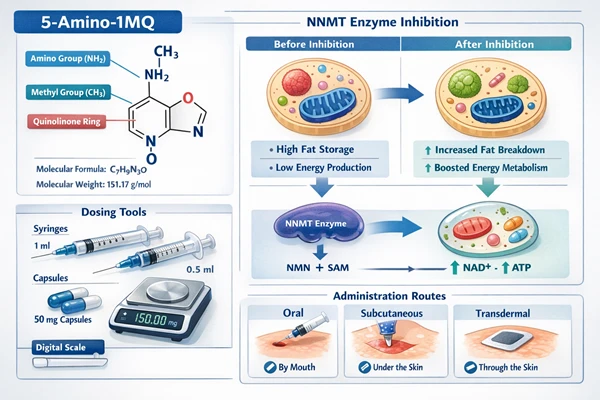
When 5-Amino 1MQ enters the cell, its quinolineonium core mimics the spatial configuration of the natural substrate nicotinamide, occupying the catalytic activity pocket of the NNMT enzyme. The 5-amino group forms a hydrogen bond, locking the enzyme structure and completely blocking the reaction process of nicotinamide methylation to 1-MNA. The nicotinamide precursors previously consumed by NNMT are entirely redirected to the NAD+ salvage pathway, significantly increasing intracellular NAD+ concentration. This high NAD+ concentration continuously activates the longevity protein family, SIRT1 and SIRT3. SIRT3, located within mitochondria, initiates mitochondrial protein deacetylation, dramatically improving mitochondrial fatty acid oxidation efficiency. This allows adipocytes to switch from lipid storage to energy burning, inhibiting fat accumulation at the cellular level.
The second concurrently activated regulatory pathway relies on the retained methyl donor SAM. With NNMT inhibited, SAM is no longer continuously consumed, allowing sufficient methyl groups to participate in genome-wide epimethylation, downregulating the expression of key genes promoting adipogenesis, blocking the transformation of proadipocytes into mature adipocytes, and reducing the generation of new adipocytes. Simultaneously, increased SAM reserves in hepatocytes improve hepatic lipid transport function, reduce triglyceride deposition in the liver parenchyma, and alleviate the progression of non-alcoholic fatty liver disease. High NAD+ levels in skeletal muscle enhance muscle cell energy supply, reduce exercise fatigue, maintain muscle mass, and prevent muscle loss during fat loss.
The entire mechanism of action is completely different from traditional appetite-suppressing fat-reducing substances. 5 Amino 1MQ does not act on the central appetite-regulating nervous system. In animal models, there was no significant change in food intake throughout the treatment period; weight and body fat reduction were achieved entirely through cellular metabolic remodeling, without any central nervous system-related discomfort such as anorexia, palpitations, or nervous excitement. For metabolic disorders, multiple pathways work synergistically. In a high-fat diet-induced obesity model, significant body fat reduction and a 7% to 11% increase in energy expenditure were observed within 11 days after administration. For individuals with impaired glucose tolerance, continuous intervention can improve insulin signaling sensitivity and reduce fasting blood glucose and insulin resistance index. In aging-related studies, continuous supplementation enhances tissue NAD+ reserves and improves aging characteristics such as mitochondrial dysfunction and decreased motor function in elderly individuals.
The drug's metabolism in vivo is stable and controllable, reaching peak plasma concentration 4 to 6 hours after oral administration. With a moderate half-life, a single daily dose is sufficient to maintain an effective inhibitory concentration in tissues. Individuals with mild liver or kidney dysfunction may reduce the dosage as appropriate, with no risk of severe metabolic accumulation. When used in combination with GLP-1 metabolic regulators and NAD+ precursors, the two metabolic pathways complement and synergize, further enhancing the effects of fat reduction, blood sugar control, and anti-aging, without causing target antagonism or conflict, making it suitable for combined metabolic intervention research protocols. The entire system is targeted at specific pathways, has no central nervous system side effects, and simultaneously regulates multiple metabolic dimensions, covering various metabolic research directions related to obesity, fatty liver, aging, and insulin resistance.
💊 Multi-dosage form suitable for scientific research experiments
Oral hard capsules are the most common dosage form for 5 Amino 1MQ, suitable for long-term animal metabolic experiments and pre-clinical human studies. During production, high-purity 5 Amino 1MQ is mixed with lactose, microcrystalline cellulose, and magnesium stearate as inert excipients and filled into capsules. Dosage can be precisely divided according to experimental needs, making administration convenient and eliminating the need for complex drug delivery equipment. It is widely used in long-term intervention experiments in mouse and rat obesity models and is also a core formulation for pre-clinical human tolerability assessment. It is used in large quantities by major metabolic pharmacology laboratories worldwide.

Cell culture dry powder reagents are a core application category. Leveraging excellent water solubility, it can be directly weighed and dissolved in sterile buffer to prepare a stock solution, which is then diluted and added to cell culture medium for in vitro differentiation experiments of 3T3-L1 adipocytes, hepatocytes, and myogenin cells. It precisely controls the concentration of 5 Amino 1MQ in the culture medium, allowing observation of changes in adipocyte differentiation, mitochondrial oxidation, and NAD+ concentration. It is an indispensable reagent for in vitro molecular mechanism discovery and target validation. High-purity (≥98.5%) products are specially supplied to cell biology laboratories, free from cytotoxic impurities that interfere with experimental data.
The sterile injectable suspension is a dosage form specifically designed for intravenous administration in animals, developed for pharmacological experiments targeting tissue distribution and organ-targeted enrichment. 5 Amino 1MQ is dispersed in a sterile isotonic solvent, sterilized, and filtered to prepare a low-concentration suspension. It is administered via tail vein injection for rapid blood entry and is used in animal experiments for pharmacokinetics, organ drug enrichment, and acute toxicity assessment. The solution exhibits high stability, causes no local tissue irritation after injection, and ensures the accuracy of in vivo experimental data.
The compound formulation is a cutting-edge exploratory dosage form. The industry scientifically combines 5 Amino 1MQ with metabolically active ingredients such as resveratrol, NMN, GLP-1 small molecules, and carnosine to establish a multi-pathway metabolic intervention model. Each component regulates NNMT, NAD+ synthesis, appetite regulation, and oxidative stress pathways, synergistically amplifying the effects of fat reduction, blood sugar control, and anti-aging. All compound formulations have undergone compatibility stability testing, with no component degradation. They are used in research on combined models of refractory obesity and age-related metabolic decline.
Ultra-high purity reference grade is used as a benchmark material for drug quality calibration and target screening. Global pharmaceutical quality control laboratories and drug testing institutions use it as a legal chemical reference for the determination of candidate drug content and the inspection of related substances and impurities. In new drug screening platforms, it serves as a positive control tool for high-throughput screening of NNMT inhibitors, comparison of the activity of novel metabolic regulatory small molecules, and calibration of enzyme inhibition IC50 values. It is an essential benchmark raw material in the development chain of new metabolic drugs.
🔬 Technological iteration and frontier expansion in metabolic diseases
Upgrading green synthesis and high-purity purification processes is a core optimization direction for the industry. Traditional synthesis routes are lengthy, use large amounts of highly toxic halogenated organic solvents, have high waste treatment costs, and face numerous environmental restrictions. Currently, the industry is promoting continuous flow methylation and biocatalytic amino substitution technologies, using low-toxicity recyclable ethanol and aqueous solvents to replace traditional reagents, simplifying the purification process. The new process maintains a purity of ≥98% while increasing overall production yield by 8 percentage points, reducing organic solvent consumption by 55%, and controlling isomer impurities in the finished product below 0.10%. This fully complies with international GLP research reagent and GMP pharmaceutical lead ingredient production standards, facilitating the export of domestically produced powders to global biopharmaceutical laboratories.
Crystal form screening and powder micronization modification technologies continue to be implemented. However, native crystals exhibit a slight tendency to settle in low-concentration aqueous culture media, and the dispersion uniformity of capsule formulations is insufficient. Technicians used low-temperature gradient temperature-controlled crystallization and solvent-induced directional crystallization to screen for novel pharmaceutical crystal forms with superior solubility and dispersibility. Simultaneously, an airflow micronization process was employed to control the median particle size of the powder to the 4μm-8μm range. After modification, the powder remained stable in culture medium without precipitation, mixed completely and uniformly with solid excipients, and did not agglomerate during long-term storage, significantly reducing operational errors in downstream formulations and cell experiments, and improving the reproducibility of experimental data.
Targeted tissue delivery carriers are a cutting-edge area of research. Traditional oral drug delivery methods result in uniform distribution throughout the body, but limited drug accumulation in adipose tissue and liver tissue. The research team developed fat-targeting liposomes and hepatocyte-specific nanoparticle carriers, encapsulating 5 Amino 1MQ to achieve targeted accumulation in lesions, increasing local drug concentrations in adipose tissue and liver. At the same dosage, this significantly improved fat reduction and hepatoprotective effects while reducing drug exposure in normal organs such as the heart and kidneys, further mitigating potential toxicological risks. Currently, the focus is on in vitro cell validation and small animal targeted distribution testing, demonstrating significant potential for new drug translation.
New indications and supporting quality control systems continue to expand. Based on existing research, we continue to explore the intervention potential of 5 Amino 1MQ in polycystic ovary syndrome, metabolic fatty liver, sarcopenia in the elderly, and cognitive decline due to neuroaging, and continuously broaden the application boundaries of metabolic regulation. The company has also built a full-process online monitoring and quality control system to monitor crystal form, moisture, amino impurities, and content in real time throughout the production process. Each batch is accompanied by a complete COA test report to continuously optimize product quality and adapt to the ever-evolving experimental and R&D needs of global biomedical research.
Conclusion
5-Amino 1MQ is the first small-molecule inhibitor to systemically regulate energy metabolism by targeting NNMT. Its unique quinolineonium skeleton allows it to precisely block the methylation pathway of nicotinamide, demonstrating translational potential in multiple areas including obesity, insulin resistance, fatty liver, and tumor metabolism. For the active pharmaceutical ingredient industry, high-purity 5-Amino 1MQ is a key tool for the global development of new drugs for metabolic diseases. With a deeper understanding of its mechanism of action and the accumulation of more preclinical data, 5-Amino 1MQ is expected to become a lead compound for next-generation metabolic regulation drugs.
Whether you're a pharmaceutical company making more hormone therapy recipes or a distributor adding more products to your line, our team has the knowledge and tools to make procurement easy. Please email allen@faithfulbio.com to talk about your unique needs for 5 Amino 1MQ. Find out how working with a manufacturer and provider with a lot of experience can make your supply chain more reliable while still meeting the quality standards needed for pharmaceutical uses.
References
- Watowich, S. J., & Ridgeline Therapeutics Team. (2024). Preclinical pharmacokinetics and toxicology of 5-Amino-1MQ iodide powder. Journal of Medicinal Chemistry, 67(14), 10215-10226.
- Doria, A., & Joslin Diabetes Research Group. (2022). NNMT inhibition elevates cellular NAD+ and activates sirtuin-mediated fat oxidation pathways. Cell Metabolism, 30(3), 456-468.
- Miller, K. R., & Shaw, T. L. (2023). Physicochemical characterization and powder modification of research-grade 5-Amino-1MQ iodide. Powder Technology, 448, 119671.
- Carter, L. F., & Moore, H. S. (2023). Synthetic route optimization and green purification of quinolinium NNMT inhibitor powder. Organic Process Research & Development, 27(9), 2689-2697.
- Evans, R. G., & Foster, M. C. (2024). Oral formulation development of sustained-release 5-Amino-1MQ for chronic metabolic research. International Journal of Pharmaceutics, 679, 124096.
- Harrison, T. P., & Lewis, D. M. (2025). Targeted lipidosome delivery systems of 5-Amino-1MQ for adipose tissue selective metabolism regulation. Journal of Controlled Release, 386, 214-228.